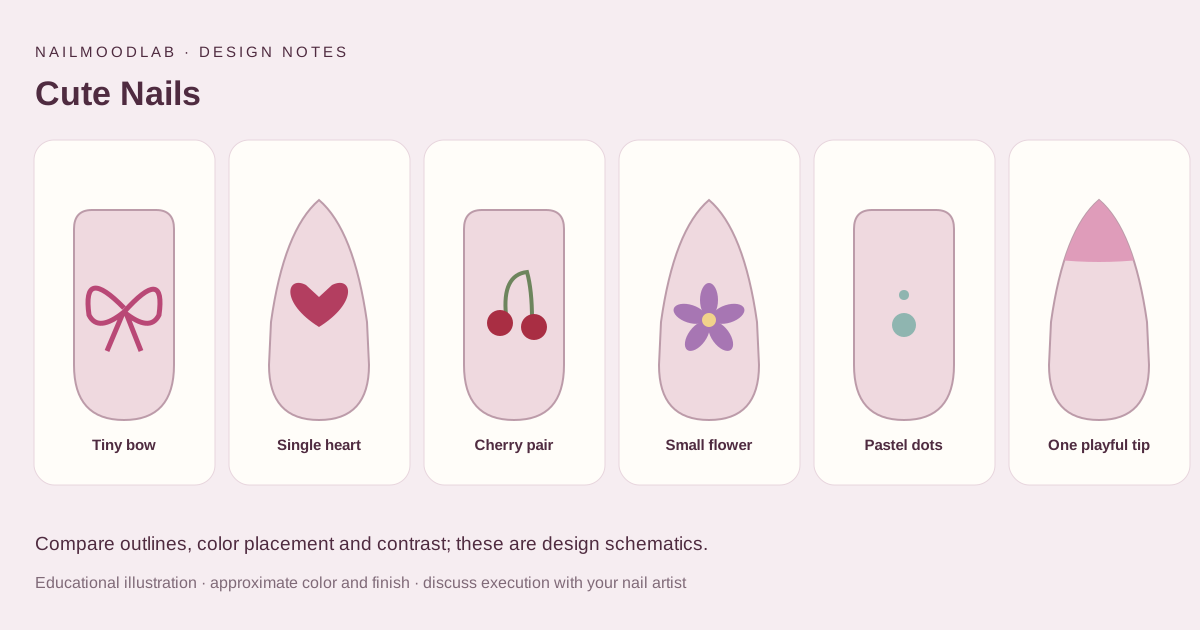
Cute nail designs are easier to choose when you identify one main motif and give it enough space to remain recognizable. A tiny bow, simple heart, cherry pair or small flower can be the focus, with a quiet background connecting the set. Decide whether you want a restrained accent or a playful manicure across all ten nails.
This guide keeps the original advice about small motifs, a limited palette and calm bases such as translucent pink, milky cream or muted lilac. It adds a chooser and links to the detailed motif guides so you can plan the design without combining every tutorial into one page.
Choose the motif and amount of art together
| Direction | Main detail | A restrained version |
|---|---|---|
| Bow | A visible knot and loops | One small bow on an accent finger |
| Heart | A simple recognizable silhouette | One tiny heart over a quiet base |
| Cherries | Fruit plus a readable stem | One cherry pair, with plain nails around it |
| Flower | Petals and center | One small flower rather than a full garden |
| Dots | Size and spacing | A few spaced dots in one accent color |
| Playful tip | Color at the edge | A pastel border without another motif |
The illustration shows simplified layout ideas, not actual manicures. It helps compare placement and empty space; it cannot determine the detail an artist can achieve at your length.
Six starting ideas for different canvases
1. A tiny bow over translucent pink
Keep the background quiet and place one bow where its loops remain visible. On a short nail, use a simplified outline rather than copying many ribbons from a longer reference. Decide whether you mean painted art or a raised decoration; those are different service requests. See the bow design guide for the detailed placement choices.
2. One small heart on a cream base
Use a single heart on a named accent finger and keep the other nails plain or lightly colored. Choose the heart color together with the background so the outline is easy to distinguish in your reference. The heart design guide compares more layouts when you want a fuller set.
3. A cherry pair with a readable stem
Leave room for the stem as well as the fruit. On a smaller canvas, simplify the pair rather than asking for a whole cluster of cherries. Repeat the fruit color in a tip or plain nail if you want the set connected. Use the cherry guide to clarify which details should remain visible.
4. A small flower on muted lilac
Choose one flower with a clear center rather than several overlapping flowers. A quiet lilac, cream or pink background can keep the motif distinct. On a longer nail, decide whether the extra space stays open or carries another flower; more length does not require more decoration. Our floral ideas guide covers the broader flower direction.
5. Spaced pastel dots
Use one or two dot colors and decide whether the dots form a line, a cluster or a scattered pattern. Keep their spacing intentional. On short nails, fewer dots can make the arrangement easier to read than a crowded pattern. For more specific dot planning, see polka-dot designs.
6. A playful pastel tip
Use a colored border as the main detail instead of adding a motif. If you want an accent, choose one small symbol on one nail and keep the border narrow enough that both features have room. The French tip guide helps specify width and base coverage.
Adapt detail instead of shrinking the whole photograph
A long reference may contain several motifs, a deep colored tip and decorative lines. Making every element smaller may leave the design difficult to interpret on a short nail.
Choose the essential element first. If it is a bow, preserve the knot and loops and simplify the trailing ribbon. If it is a cherry, preserve the fruit-and-stem relationship. If it is a flower, keep a clear center and fewer visible details.
Tell the artist which element can be removed if needed. That makes adaptation a shared decision rather than an unexpected change after the appointment starts.
Decide where the set repeats
You can place the same small motif on every nail, repeat it on two accent fingers, or vary the motif while keeping a common base. Each is a different composition.
For a quiet set, try one motif per hand and repeat one accent color elsewhere. For a more playful set, choose two related motifs—such as a bow and a heart—then keep their scale and palette connected. Avoid leaving “cute details” open-ended if you have a specific arrangement in mind.
Name left and right fingers separately when the design is asymmetric. A screenshot of one hand may not tell the artist how you want the other arranged.
Painted art and raised details need different requests
A drawn bow and a raised bow may share a shape but differ in the actual work involved. Tell the artist which appearance you mean and ask about the products, appointment scope and suitability of the proposal.
If your routine limits raised details, state that as a constraint and ask about a painted interpretation. Do not assume a flat-looking AI concept proves a decoration will sit flat or feel comfortable.
Build a clear reference in five steps
- Choose one main motif.
- Select the base color and coverage.
- Set the length and outline.
- Mark the fingers and any repeated accent color.
- Ask the artist what simplification is needed and confirm the complete quote.
For example: “Short squoval nails with a translucent pink base, one small painted burgundy bow on each ring finger and plain pink on the others. Please keep space around the bow; I do not want a raised charm.”
You can generate variations with NailMoodLab, then use virtual try-on to compare concepts on a hand photo. Digital previews are inspiration, not exact salon results or physical-suitability checks.
Questions readers ask
Can cute nails be subtle?
Yes. Choose one small accent and leave the rest of the set quiet. Show the amount of art you want rather than relying on subtle alone.
Do short nails need a particular cute motif?
No. Choose the detail you like, then discuss its simplification at your length. A picture of a longer set is a starting reference, not a fixed layout.
Can I mix motifs?
You can propose that. Decide the shared base, accent colors and finger arrangement first so the set has a clear plan.