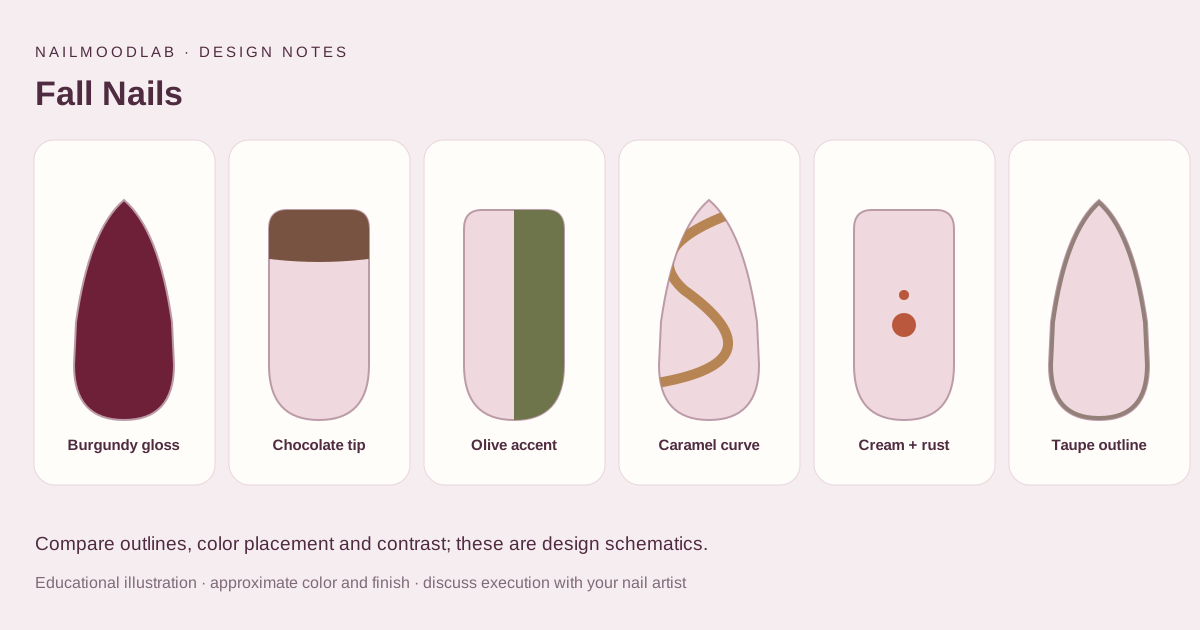
Fall nail designs can start with an autumn palette rather than a literal leaf or pumpkin. Pair one deep shade—burgundy, aubergine, chocolate or forest green—with a quiet neutral, then decide whether the season appears through color, finish or a small motif. That keeps the manicure focused instead of asking every nail to carry several ideas.
This guide expands the original palette-and-finish advice into a chooser. Sally Beauty's autumn inspiration is one reference for seasonal color directions. The examples below are proposed layouts; the illustration is not a photograph of completed salon work.
Choose a palette before a motif
| Mood you want | Color direction to compare | A simple layout |
|---|---|---|
| Deep and quiet | Burgundy or aubergine with blush | Mostly solid color, one pale accent |
| Warm and soft | Caramel with cream | Warm tips over a pale base |
| Earthy | Olive or forest green with beige | One green accent or a green border |
| Dark and graphic | Chocolate or espresso with cream | A fine line or clear negative space |
| Subtle seasonal detail | Taupe with copper-looking contrast | One narrow decorative line |
These descriptions do not identify exact polish shades. Compare the actual base and accent colors together, especially if your reference was photographed under warm indoor lighting.
Six autumn directions you can adapt
1. Burgundy color with a blush accent
Use a deep red on most nails and a quiet blush background on a named accent finger. Keep extra decoration off the other nails if the color contrast is the main idea. At a short length, one small detail on the blush nail can be easier to communicate than an elaborate motif.
2. Chocolate French tips
Put brown at the edge rather than over the whole nail. Decide whether you prefer a narrow border or a more substantial colored tip. The brown design guide helps compare chocolate, caramel and espresso directions without turning the whole set into a seasonal collage.
3. Olive or forest-green contrast
Pair one green direction with cream or beige. You could use green across the set with one neutral nail, or reverse the balance and use green only in a tip or curve. State which color should occupy most of the manicure; “green and beige” does not settle that.
4. Caramel curves over cream
Use a warm brown curve against a pale background, leaving open space around it. On short nails, choose one main curve rather than several overlapping paths. On longer nails, discuss where the curve begins and ends so it does not disappear into the tip.
5. Cream with one copper-looking line
Keep the base calm and add a fine metallic-looking accent. Specify whether you mean a reflective line, a shimmer detail or a colored line that merely looks copper-toned. Those references may involve different products and appointment work; the artist should confirm the execution.
6. A restrained pattern accent
Use a brown-and-neutral pattern on one or two nails while keeping the rest simple. A tortoiseshell direction gives you a specific pattern to discuss. If you choose leaves or another motif instead, show its size and placement rather than asking for several seasonal symbols together.
Let finish carry some of the seasonal mood
The original guide suggested comparing a glossy-looking tip with a matte-looking base. That remains a useful visual direction: surface contrast can add interest without another color or motif.
Another option is a softly glowing finish in a deep shade. The velvet design guide distinguishes diffuse magnetic glow from a sharper cat-eye line. Show a moving-light reference if the reflection matters; a still image may not capture the appearance you are trying to request.
Ask what finish the artist can create with the products available. A matte, glossy or magnetic label does not by itself establish maintenance, wear or price.
Adapt the layout to your length
For very short nails, choose the main idea: a color, a fine edge or one small accent. Avoid trying to shrink every detail from a long reference. Tell the artist which part should survive if simplification is needed.
At a longer length, you have a different layout to plan, not an obligation to add more art. A quiet solid color or narrow line may still be what you want. Compare references at similar lengths before deciding how much pattern belongs in the set.
If your shape is undecided, settle that separately. Autumn colors do not require an almond or coffin outline; show the silhouette you intend to wear and ask the technician to assess its feasibility.
Build a ten-nail plan
Choose the main shade, the secondary shade and the accent fingers. Decide whether both hands repeat the same arrangement. This prevents “a little fall art” from becoming a different composition on every nail.
For example, use burgundy on most nails, blush on each ring finger and one small brown curve on each blush accent. Another direction is cream across the set with caramel tips and one copper-looking line on a single middle finger.
Use these as starting proposals. The artist should assess the detail level, available products and appointment scope before the plan is final.
A prompt and a salon request serve different purposes
For a visual concept, try: “Short squoval nails, cream base, narrow caramel French tips, one small copper-colored accent line, quiet autumn palette, no leaves or pumpkins.”
Use NailMoodLab to compare a few visual directions. Its output is a concept; it cannot identify the exact polish, assess physical suitability or promise the finished result.
Then translate the chosen idea into a salon request: “This is the palette and tip width I like. I want to keep this short length. Can you confirm whether the metallic-looking line is available and quote the complete design?”
Mistakes to avoid
- Asking for brown, burgundy, green, leaves and shimmer without deciding which is the main idea.
- Using warm lighting as proof of an exact shade.
- Copying the size of a motif from a much longer nail.
- Leaving accent placement or finish out of the booking request.
Questions readers ask
Can fall nails be simple?
Yes. A deep color with a quiet neutral, or one warm border, can be your entire autumn direction. Literal motifs are optional.
Do I need dark colors?
No. Cream, taupe and caramel offer lighter starting points. Compare the palette you want rather than following a fixed seasonal rule.
What if I want Halloween details too?
Choose one named motif and show its size. Keep it separate from the broader autumn palette so the artist knows which detail is essential and which can be simplified.