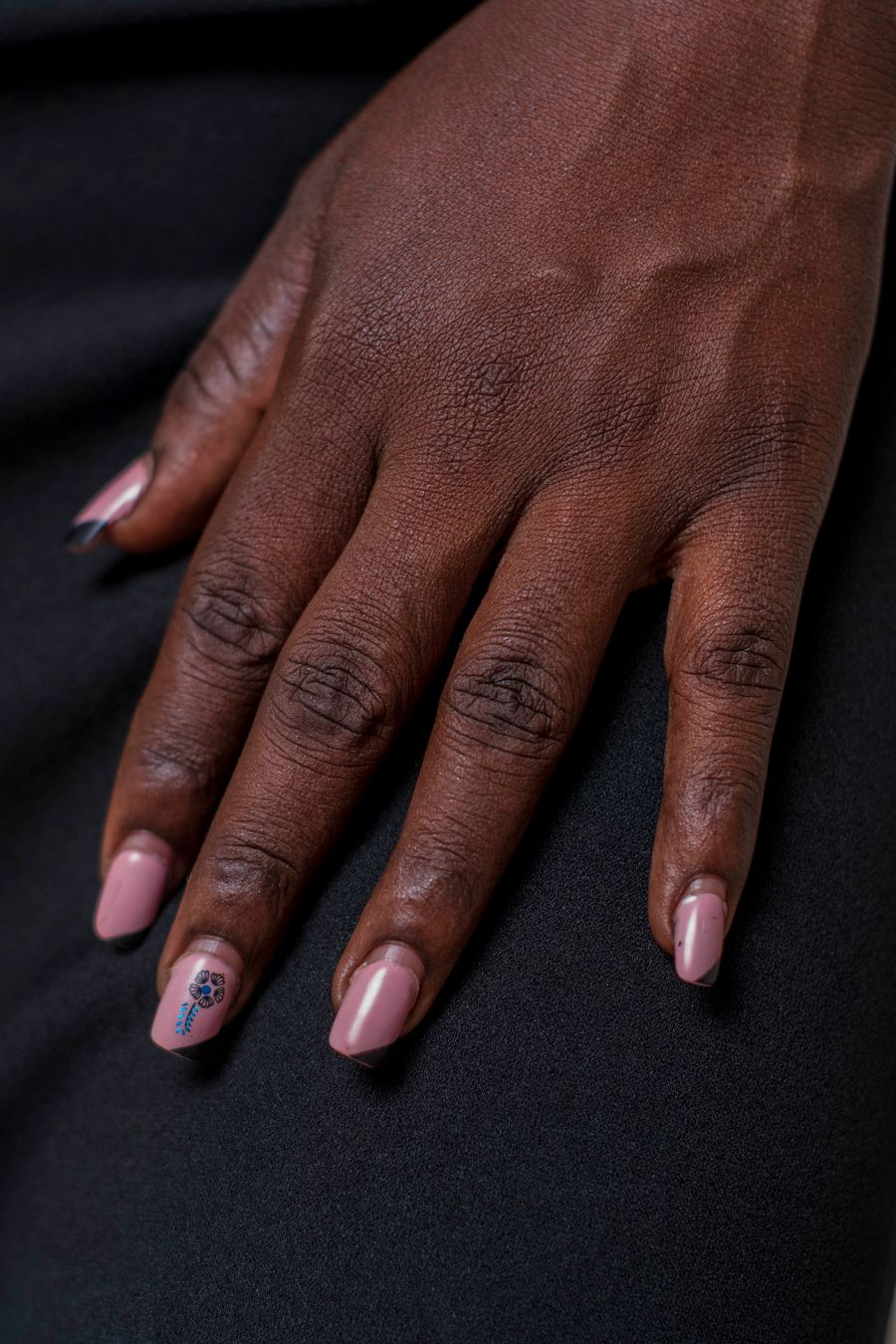
Minimalist nail art looks intentional when deliberate placement, disciplined spacing, and clean negative space define the composition. Instead of covering the entire nail plate, an effective minimalist manicure uses unpainted surface area to establish balance, ensuring that a simple dot or single line reads as a purposeful design rather than an incomplete set.
Crucially, minimalism does not restrict you to sheer or neutral tones. Minimalist art relies on restrained placement, spacing, and negative space rather than a fixed color palette. A bold black line, an emerald micro-dot, or an unpainted geometric cut-out can each achieve a refined look when applied with structural intention.
Defining Key Concepts: The Mechanism of Restraint
Understanding basic terminology helps clarify design choices:
- Negative Space: The unpainted portion of the natural nail bed or sheer base that frames graphic elements.
- Motif: A repeating decorative element, such as an isolated dot, a clean stripe, or a geometric shape.
- Accent Nail: A designated finger featuring distinct art while adjacent nails remain understated.
As detailed in Nail Designs HQ's guide to minimalist freehand nail designs, intentional minimalism depends on balanced proportions between bare nail area and hand-placed marks, preventing crowded placements that obscure the design's focal point.
Visual Reference
Distribution Strategy: One Motif per Nail vs. The Accent Nail
How you distribute art across your hands shapes the overall aesthetic:
- One Motif per Nail: Applying an identical graphic mark—such as a single centered dot or vertical line—to every nail establishes rhythm. Because each digit carries equal weight, visual repetition unifies the set.
- The Accent Nail: Confining artwork to one or two fingers preserves open negative space on the others. This concentrates attention on the focal finger while maintaining an understated profile.
Dot and Line Placement: Adapting to Nail Length
The physical dimensions of your nail bed determine how graphic elements interact with your hands:
- Dot Positioning: As noted in The Neo Glow's guide to polka dot nails, dot scale and location alter the nail's perceived geometry. Placing a single dot near the cuticle anchors the plate, while off-center placement introduces asymmetrical interest.
- Linework and Short Nails: On short nails, vertical lines visually lengthen compact nail beds. Horizontal lines section the surface into distinct blocks.
- Edge Detailing: Running a micro-line along the free edge highlights the perimeter without the density of a traditional French tip.
Before committing to a full set, compare the placement of one sample dot or line on two nails. This makes the scale easier to judge against your own nail length.
Negative-Space Edges and Set Coherence
Negative space is an active design element. To keep a minimalist set coherent:
- Maintain Crisp Borders: The boundary between color and bare nail must be sharp. Uneven edges disrupt the intentional aesthetic.
- Unify Color Accents: When using multiple motifs across fingers, use a consistent accent color to bind the set together.
- Match Proportion to Nail Size: Scale dots and line thickness to nail bed width so smaller fingers do not look overcrowded.
Common Mistakes and Execution Trade-Offs
- Crowding Short Nails: Oversized elements overwhelm short nail beds, eliminating the breathing room negative space provides.
- Inconsistent Alignment: In a repeating motif set, uneven distances from the cuticle read as application errors.
- Treating AI Renders as Guarantees: Virtual generators render mathematically straight lines, but natural nails have natural curves and arches. Freehand salon execution requires manual adjustment.
Minimalist Decision Checklist
Choose an All-Over Motif If:
- You want visual rhythm across all fingers.
- You prefer subtle repetition, like a micro-dot near the cuticle.
- You wear short nails and want simple detail without heavy polish layers.
Choose an Accent Nail If:
- You prefer maximum bare nail space with a single focal point.
- You want a distinct geometric or linear design without cluttering adjacent fingers.
Salon Protocol: How to Brief Your Technician
Clear communication ensures precise execution. Request a test nail before completing the set:
- "I would like a minimalist negative-space manicure over a sheer base, with one small dot placed just above the cuticle line on each finger. Could we do one sample nail first to confirm the dot size and placement?"
Checking one completed nail verifies scale and alignment before your technician shapes the rest of your hands.
Planning Your Set with NailMoodLab
Explore concepts digitally before your appointment. Use NailMoodLab's nail shape analysis to evaluate proportions, preview shades with virtual nail try-on, or generate fresh concepts on the NailMoodLab home platform.
Digital previews clarify preferences but cannot replace hands-on salon assessments. Consult your technician to confirm that your selected design suits your natural nail curvature and daily routine.