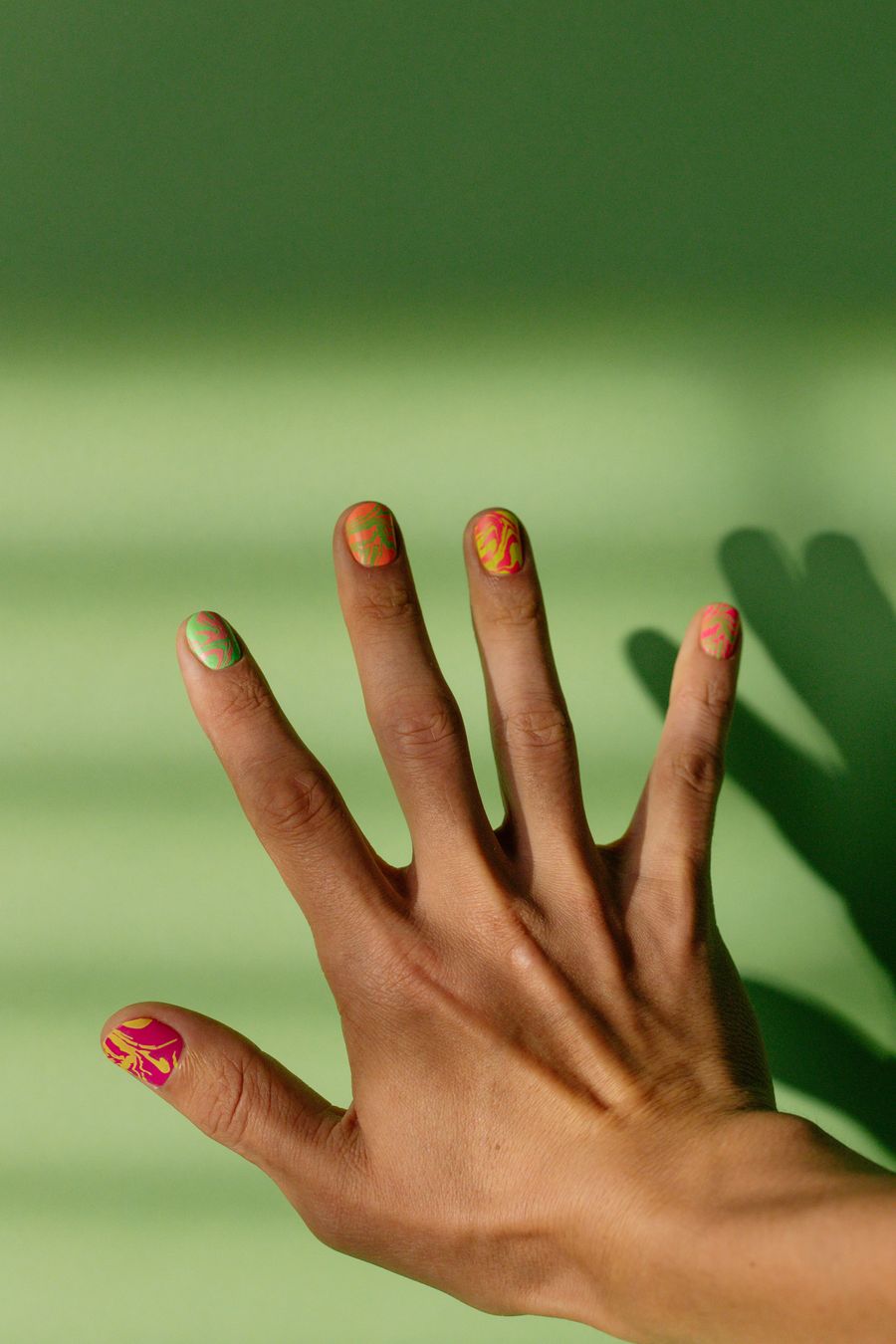
Short nails can be practical and expressive. Whether you type, play an instrument, or simply prefer a compact manicure, you can choose art that fits your natural nail surface.
However, searching for manicure inspiration can quickly become frustrating. Most online galleries showcase intricate nail art on long acrylics or naturally elongated nail beds. When transferred directly to a short nail, those same patterns can look crowded, heavy, or visually truncated.
NailMoodLab offers a nail shape analysis tool and a virtual try-on for exploring concepts on a hand photo. This guide helps you choose simple short nail designs for your actual nail-bed space, whether you paint at home or visit a salon.
Short Length vs. Small Nail Beds: Why Proportion Matters
Before choosing a design, it helps to distinguish between two common nail characteristics that are frequently confused in beauty discussions:
- Short Free-Edge Length: This refers to the white tip of the nail extending past the pink nail bed. You may have long, naturally oval nail beds but choose to file the free edge down flush with your fingertips for practical tasks or sports.
- Small or Short Nail Beds: This refers to the actual pink surface area attached to your fingertip. As highlighted in community discussions on r/RedditLaqueristas and r/Nails, wearers with small or narrow nail beds often find that standard short-nail inspiration still displays significantly more surface canvas than they have available.
The usable design area depends on both the nail plate and any free edge. Looking at both is more useful than choosing from a photograph labeled only “short nails.”
Understanding this distinction changes how you approach nail art. If you have plenty of nail-bed space but zero free edge, you can wear central motifs, negative space, and lunula cuffs easily. If your nail bed itself is small or narrow, thick borders and busy patterns visually cut the nail in half. Treating proportion as an aesthetic visual guideline—rather than a rigid physical rule—helps you choose placements that keep your hands looking open and balanced.
How to Choose: Short Nail Design Selection Table
Use this reference table to match designs against your available free edge, nail-bed size, and daily routine:
| Design Style | Free Edge Required? | Best Nail-Bed Fit | Daily Lifestyle & Activity | Execution Complexity |
|---|---|---|---|---|
| Sheer Neutral Solid | None (flush to skin) | Any size (small, wide, narrow) | Typing, instrument playing, active routines | Quick DIY / Basic Salon |
| Micro-French | A visible edge helps | Beds with enough room for a thin tip | Office or formal events | Steady DIY / Salon |
| Reverse French (Lunula Cuff) | None | Short to average nail beds | Keyboard work, active sports | Easy DIY / Salon standard |
| Minimal Dot Placement | None | Ideal for very small or narrow beds | Daily casual, clean minimalist aesthetic | Beginner DIY |
| Single Accent Motif | None | Small to medium nail beds | Weekend outings, creative workplaces | Beginner DIY (one finger) |
| Slim Vertical Stripe | None | Small, square, or wide nail beds | Typing, professional settings | Moderate DIY (brush control) |
| Negative Space Half-Dip | None | Compact to average beds | Low-maintenance grow-out cycles | Easy DIY / Salon standard |
| Restrained Cat-Eye / Chrome | None | All bed sizes | Evening wear, understated glam | Salon recommended (gel/magnet) |
8 Concrete Short Nail Designs That Flatter Limited Space
Here are eight balanced short nail designs that prioritize breathing room and visual proportion:
1. Sheer Neutral Solid with High-Gloss Finish
A translucent blush, milky off-white, or sheer beige wash is a straightforward work-friendly choice. The finish leaves the natural nail visible while adding color. Because it does not depend on a painted tip, it also works on nails trimmed flush with the fingertip.
2. The Micro-French
Unlike traditional French manicures that feature a thick white band across the upper third of the nail, the micro-French uses an ultra-fine, hairline stroke along the natural free edge.
- Suitability note: A visible free edge makes it easier to place a clean, thin line. If you have no edge to trace, try a reverse French line near the base instead.
3. Reverse French (Cuticle Lunula Cuff)
Instead of highlighting the tip, this design traces a delicate curve of metallic, pastel, or dark lacquer right above the cuticle line. By anchoring the contrast at the base, it leaves the rest of the nail open, making it an exceptional option for very short nails with zero free edge.
4. Minimal Single-Dot Placement
A single micro-dot placed near the base of each nail—or centered on an accent finger—adds intentional styling without taking up precious surface area. Using a neutral base with a black, forest green, or gold dot provides a clean, cute finish that fits even the smallest nail beds. Explore more subtle accents in our minimalist nail art guide.
5. Single Micro-Floral Accent
Covering all ten small nails in floral patterns can feel crowded, but a miniature daisy or petal cluster on one accent finger leaves room around the design. For more placement options, see our floral nail guide.
6. Slim Center Vertical Stripe
A single hairline stripe drawn vertically down the center of the nail draws the eye upward along the finger's natural axis. This works particularly well for wide or squoval short nails, providing a modern, graphic look using standard cream polishes.
7. Negative Space Half-Dip or Diagonal Block
Negative space designs leave portions of the natural nail visible under a clear base coat. A soft diagonal block or curved half-dip across one side creates contrast while keeping much of the nail open.
8. Restrained Velvet Cat-Eye or Soft Chrome Glaze
As seen in trend coverage from Vogue and Allure, magnetic cat-eye and fine chrome finishes give short nails dimension without requiring complex surface art. A velvet-style cat-eye disperses shimmer evenly across the whole plate, catching the light as your hands move across a desk or instrument without adding visual weight.
Easy DIY Steps (No Specialized Tools Required)
You do not need professional dotting pens or striping brushes to create polished short nail designs at home. Everyday household items work effectively:
For dots, use the rounded end of a clean bobby pin or a blunt toothpick. For a straight color block, painter's tape can help once the base is fully dry. A fine brush is easier to control than a toothpick for longer lines.
- Prep and shape: File the free edge to the short shape you prefer. If there is no free edge, avoid filing the fingertip skin.
- Apply a sheer base: Apply a thin coat of clear or semi-sheer polish. Let it dry fully before adding detail.
- Place Your Detail:
- For dots: Dip the rounded plastic tip of a clean bobby pin into a drop of polish on a piece of foil, then lightly touch it to the nail once.
- For lines: Rest your hand flat on a table to stabilize your wrist. Lightly skim the tip of a toothpick across the nail.
- Finish: Once the detail is dry, apply a clear top coat according to the polish instructions.
What to Tell Your Nail Tech: A Copyable Salon Brief
When visiting a salon, communicating your desire for proportion helps your technician adjust their standard technique for short nails. You can copy or adapt this concise brief:
Salon Request Brief: "I want to keep my natural short length with [soft round / squoval] edges. Please scale the line work to my nail-bed size and leave some open space. I'd prefer a sheer neutral base, with the accent [at the base / as a single small dot / on the ring finger only]. Can you show me the placement on one nail before doing the full set?"
Common Design Pitfalls and Digital Preview Limits
When styling shorter lengths, watch out for these frequent mistakes:
- Overly wide tip bands: A thick French line can dominate a short plate. Compare a thinner sample line before committing.
- Heavy Horizontal Color Blocks: Horizontal stripes cut the vertical visual line across the finger.
- Overcrowded Motifs: Placing multi-color stickers or large gems on small beds leaves no resting space for the eye.
Understanding Digital Previews
NailMoodLab's AI design generator and virtual try-on tools offer convenient visual mockups to test color pairings and general aesthetics before you start painting. However, digital previews are conceptual planning guides. They do not simulate exact physical polish viscosity, natural nail plate curvature, lateral skin fold depth, or real-world lighting. Always use virtual try-ons as an inspirational starting point rather than a physical guarantee of salon results.
Frequently Asked Questions
Can you do nail art on very short or bitten nails?
Yes. If your nails are trimmed completely flush with your skin or have very short beds, prioritize designs that anchor near the base or center of the nail, such as reverse French cuffs, minimal single dots, or sheer washes. Avoid micro-tips until a tiny margin of free edge grows out.
What nail shape works best for short nail designs?
Soft squoval (a flat top with rounded corners) and soft round are useful starting points. The best choice depends on your available edge, natural nail shape, and preference; the shape analysis tool can help you compare visual options.
How can I make short nail art professional for conservative workplaces?
Stick to sheer, milky, or muted neutral bases paired with minimal, single-color accents—such as an ultra-thin white micro-French, a soft metallic cuticle line, or tiny monochrome dots. These styles look deliberate and groomed without drawing excessive attention.