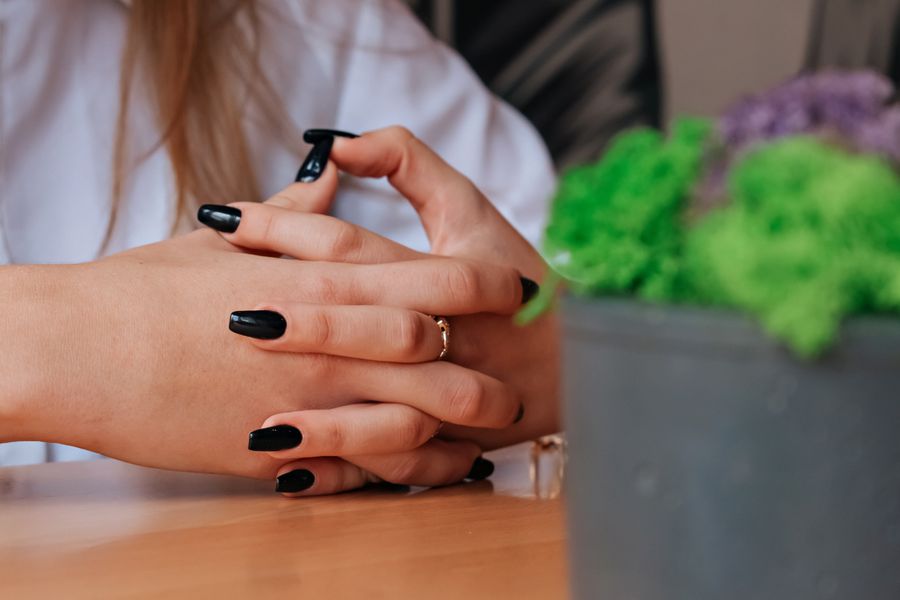
Choosing between square and squoval nails balances crisp geometry against everyday wear. Both silhouettes feature a flat free edge, but their corners behave differently in daily life. Understanding how geometry, length, and routine tasks align helps you choose the right shape.
Direct Answer: Defining Square and Squoval
The primary difference between square and squoval nails centers on how the outer corners are shaped:
- Square Nails: The free edge is filed straight across, meeting parallel sidewalls at crisp 90-degree angles to create an architectural silhouette.
- Squoval Nails: Combining square and oval, this shape keeps a flat horizontal edge across the center while gently rounding off sharp corners. The amount of corner rounding is a visual preference, ranging from slightly softened edges to gentle arcs.
As explained in Essie's nail shape guide, square shapes emphasize straight contours, whereas squoval provides a softer profile blending flat and curved lines. Similarly, Shangmeng Nails' squoval guide notes that squoval retains a structured flat edge without sharp outer points.
Understanding Free-Edge Geometry
To evaluate which silhouette fits your routine, consider three anatomical points:
- Free Edge: The nail plate extending beyond the fingertip.
- Sidewalls: The parallel borders along the sides of the nail bed.
- Corners: The intersection where sidewalls meet the horizontal edge.
Side by side, square nails maintain a rectangular outline with right angles. Squoval curves those corners, preserving a flat center while eliminating catch points.
How to File Each Shape
Filing technique determines whether you achieve crisp corners or softened edges:
- Filing Square Nails: Hold your file perpendicular to the nail bed. File across the free edge in one direction to establish a level horizontal line. Keep sidewalls straight, leaving the 90-degree corners sharp.
- Filing Squoval Nails: File the center free edge straight across as you would for square. Next, angle the file against each corner and use light, curved strokes to soften the sharp points toward the sidewalls.
Daily Wear: Corner Snagging, Typing, and Short Nails
Everyday hand use highlights practical trade-offs between both outlines:
- Corners and fabrics: If sharp corners bother you when handling clothing or hair, compare a slightly rounded squoval corner before deciding.
- Typing and hand tasks: Consider how the corners feel during the activities you do most. Shape one sample nail first if you are unsure.
- Suitability for Short Nails: Both shapes flatter short nails because neither requires significant free-edge length past the fingertip. On shorter nails, squoval complements fingertip contours while keeping a structured line.
Concrete Style Examples
- Crisp Square: Short nails with a straight edge and sharp corners, paired with monochrome polish or classic French tips.
- Soft Everyday Squoval: Medium nails with a level center and softened corners, finished in neutral cream or sheer tones.
- Deep-Curved Squoval: A transitional outline featuring pronounced corner rounding approaching an oval curve while keeping a flat center.
Trade-Offs and Common Mistakes
- Rounding more than intended: If you want squoval rather than oval, keep a visibly flat center at the tip.
- Ignoring a rough edge: Ask your technician to check the corners before you leave, especially if you prefer a crisp square outline.
- Treating Renders as Guarantees: Digital previews illustrate silhouette harmony, but natural nails feature unique curvature and thickness requiring hands-on evaluation.
Concise Decision Checklist
Choose Square If:
- You prefer crisp geometric lines and graphic silhouettes.
- Your routine involves minimal contact with snag-prone fabrics.
- You enjoy the defined look of 90-degree corners.
Choose Squoval If:
- You want a flat tip without sharp points catching on fabrics.
- You spend significant time typing or handling active chores.
- You prefer softened corners that follow fingertip anatomy.
Salon Protocol: What to Ask Your Technician
To avoid shape misunderstandings, ask for a single test nail before finishing your set:
- For Square: "I would like a clean square shape with a flat edge and crisp 90-degree corners. Could we shape one sample nail first so I can check the edge?"
- For Squoval: "I would like a squoval shape with a flat center and softened corners. Could we shape one test nail first to confirm how much rounding I prefer?"
Frequently Asked Questions
Can you switch from square to squoval without losing length?
Yes. Because squoval softens existing corners, a technician can round outer points without shortening the edge.
How do you return from squoval to square?
Returning to square requires letting corners grow out to align with the flat edge, or lightly filing down the center edge to meet the corner base.
Planning Your Silhouette with NailMoodLab
Before booking your salon visit, explore silhouettes digitally. Use NailMoodLab's nail shape analysis to evaluate hand proportions. Preview colors with virtual nail try-on or generate design concepts on the NailMoodLab home platform.
Digital tools offer helpful visual guides to clarify preferences. Consult your nail technician to evaluate what best suits your nail length and daily routine.