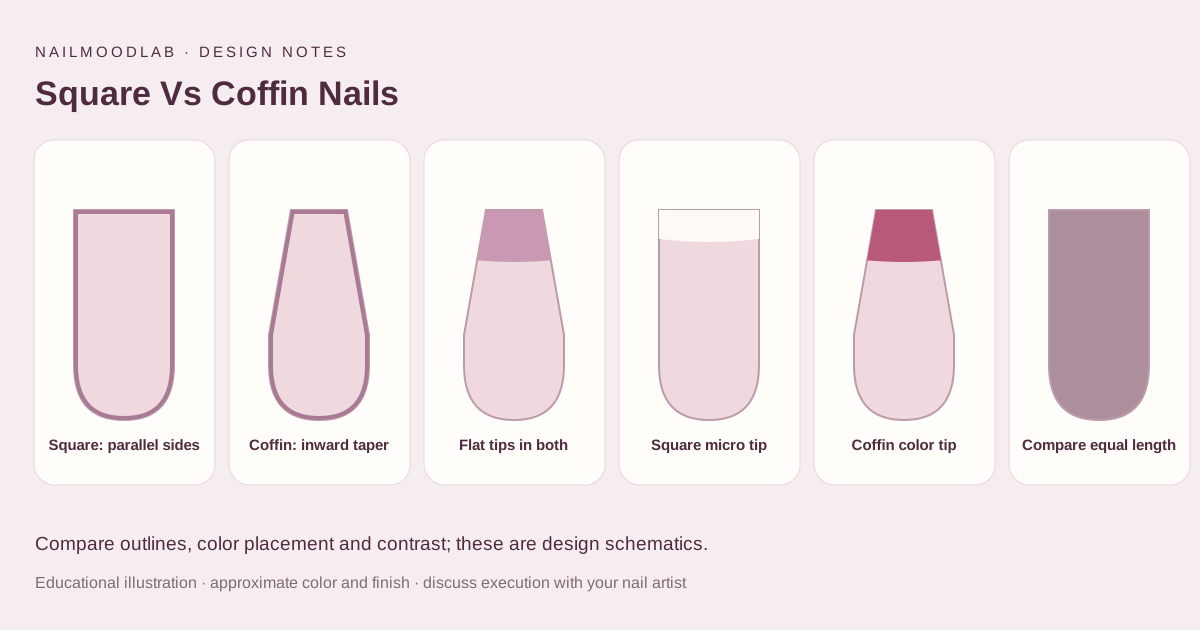
Square and coffin nails both have a flat-looking tip. Their main outline difference is the sides: square nails keep the sides closer to parallel, while coffin nails narrow toward the flat end. Look at that taper before judging the shape from the end alone.
OPI's shape guide describes the coffin outline as tapered with a squared end. The terminology can become less clear with short lengths or a gently tapered square. A useful request identifies the side angle and tip width rather than relying on the name alone.
The difference you can see from above
| Detail | Square | Coffin |
|---|---|---|
| Sides | Closer to parallel | Narrow inward toward the end |
| Tip | A relatively broad flat edge | A narrower flat edge after the taper |
| Corners | Can be sharper or softened; specify | Can also be sharper or softened; specify |
| At a shorter length | The flat edge may be easy to identify | A subtle taper may be harder to distinguish |
| Shape request | “Keep the sides mostly parallel” | “Narrow the sides toward a flat tip” |
These describe an outline, not a physical recommendation. An artist needs to assess what is feasible for your nails, intended length and service.
Where tapered square fits
Tapered square is a useful description when you want a small inward angle but do not want a noticeably narrow coffin tip. It is an intermediate visual request, and salons may use the labels differently.
In a public discussion about a requested coffin set, readers disagreed over square, tapered square and coffin. That is an example of naming ambiguity, not proof that one outline is correct for every short nail.
Instead of debating the label, mark the outline on your reference: sides almost parallel, a gentle inward angle, or a more pronounced taper. Then identify the width of the flat end you like.
Compare equal lengths before deciding
A long coffin set and a short square set change two things at once. Your preference may be for the length rather than the taper. Start with photographs or concepts that have similar visible length, angle and color.
- Keep the hand view and length as similar as possible.
- Use a quiet solid color so the outline is easy to see.
- Compare the inward angle of the sides.
- Compare how wide the flat tip remains.
- Finally, compare the corner treatment.
The first two outlines in our schematic have matched overall height so the difference in taper is visible. They are simplified shapes, not fitted extensions or recommendations for a particular hand.
If you are undecided about length itself, use the nail length guide first. A reference described as medium by one maker may be labeled differently by another.
What changes when the nails are short?
With less visible length, there is less room to display an inward taper. A short coffin reference may therefore resemble a softly tapered square. That does not require you to choose a longer manicure merely to make the label obvious.
Show the short outline you actually like and ask what can be achieved at that length. If the technician proposes another silhouette, ask to see the difference rather than treating a shape name as a requirement to file or build a particular way.
Corner softness is also independent of the side angle. If that is your main concern, the square versus squoval comparison is the more relevant next page. It focuses on a square outline with softened corners rather than an inward taper.
Three design layouts to compare
Solid color to make the outline visible
Use the same color on both candidates. Compare the border against the background rather than judging from a patterned surface. A straight-on view is helpful; a tilted hand can make one side look narrower than the other.
A fine French edge
Keep the colored border similarly narrow in both references. On square nails it follows the broader flat end; on coffin nails it follows the narrower end and taper. Specify the curve and width separately, since a deep French tip can change how the shape appears.
A motif placed toward the center
Choose one small motif rather than letting artwork fill the entire surface. Compare how much space remains on either side of it. If the narrower coffin tip crowds a detail near the edge, move that detail toward the center or simplify it with the artist.
Routine is a separate decision from appearance
Think about typing, contact lenses, gloves, musical instruments or other tasks that matter to you. Describe the length and outline you have found comfortable in the past. A shape comparison cannot establish whether a new service will suit those activities.
Do not assume square is automatically practical or coffin automatically difficult. Actual length, the service used and your own experience matter. Ask the technician to assess the proposed set and explain any adaptation needed.
A precise salon request
For square: “I would like this visible length, mostly parallel sides, a flat tip, and softly finished corners. Please avoid the inward taper shown in the other reference.”
For coffin: “I would like this length with the sides narrowing toward a flat end. I prefer this tip width, not a pointed almond end. Can you assess whether that outline is feasible with the service we are booking?”
If your question concerns coffin and ballerina terminology, see coffin versus ballerina nails. That comparison addresses labels within the tapered, flat-ended family.
You can compare outline concepts with NailMoodLab's shape tool, using its suggestions as visual ideas. It does not measure physical fit or confirm the structure of an enhancement.
Questions readers ask
Is a flat tip enough to identify square nails?
No. Coffin also has a flat end. Look at the side taper as well as the tip.
Can square nails have softer corners?
You can request softened corners separately. Show how much softness you want, and use a squoval reference if the rounded-corner square appearance is your priority.
Which shape makes my fingers look longer?
That is an appearance preference to compare on your own reference, not a universal rule. Hold length and color constant before deciding whether you prefer the tapered silhouette.