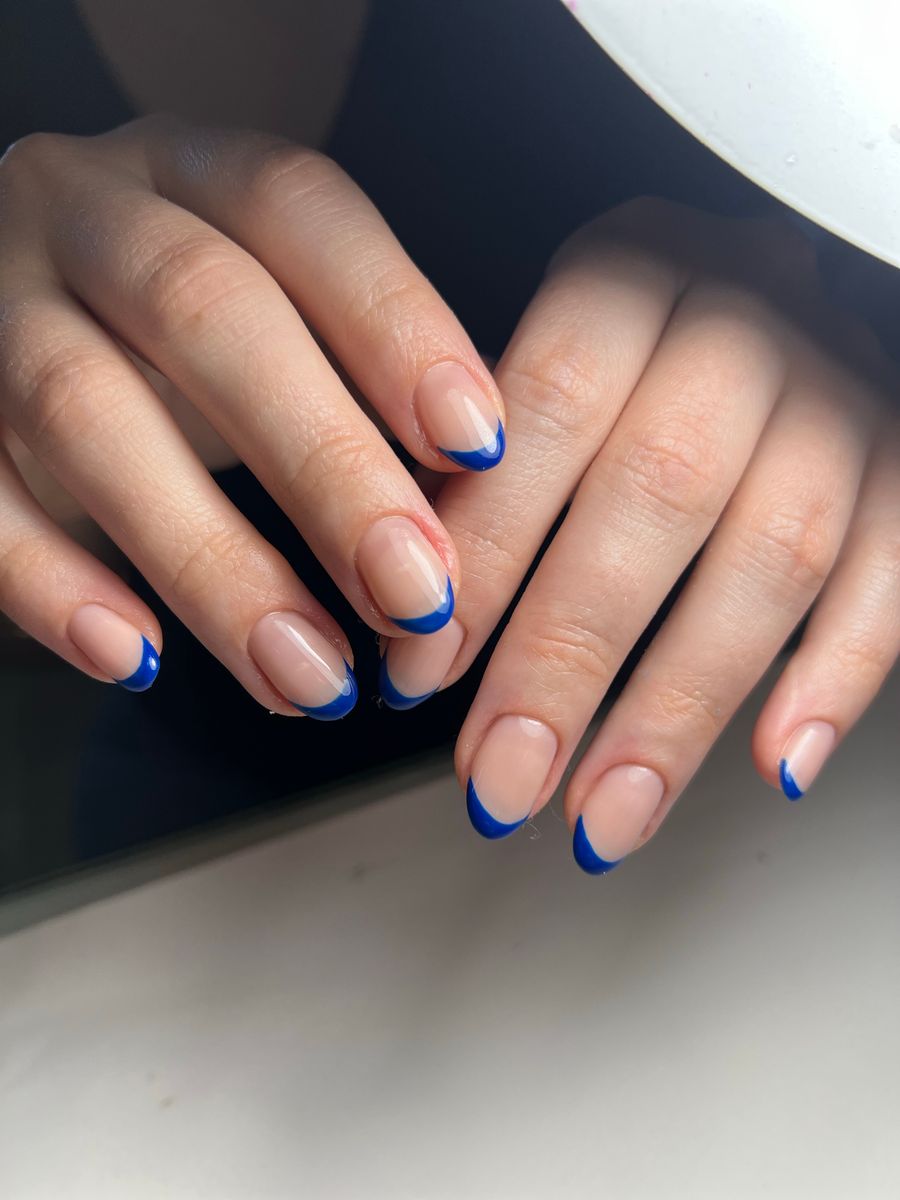
Choose accent nail placement by deciding what should stand out, then where you want to see it. The ring finger is an option, not a compulsory location. An index, middle, thumb, or little-finger accent can serve a different composition depending on the motif, your nail shape, and your usual hand views.
Before booking, specify whether “one accent” means one nail across both hands or one on each hand. Then write the exact left-and-right placement for your artist. A reference image alone may leave both questions unanswered.
Give the accent a job before giving it a finger
An accent can introduce a contrasting color, carry the set's main artwork, or change the finish while the palette stays similar. Identify which role matters most so you can judge placement without changing the entire design.
A solid contrasting nail asks you to compare color distribution. A detailed motif asks whether the available space supports the parts you want to see. A subtle finish change may be something you notice mainly when you move your hand rather than an obvious focal point in every view.
For example, a marble accent surrounded by plain nails can carry the main pattern. If that is your plan, settle the vein scale separately using Marble Nail Ideas. The placement decision is where that pattern should sit within the set, not how every vein should be drawn.
Similarly, refine a tortoiseshell pattern separately from its placement. An accent does not need extra decoration simply because it is designated “special.”
Look at your hands in the views you actually use
Rest your hands naturally, look at them while holding a familiar object, and notice which nails you enjoy seeing. A posed reference with curled fingers may emphasize a different part of the hand from your daily view.
Try considering the same motif on two candidate fingers without changing its color or finish. Ask where you want the focal point to sit: toward the center of the visible nails, nearer an edge, or on a nail you frequently notice yourself. There is no need to turn that preference into a universal placement rule.
If a ring or other jewelry matters to the overall look, consider it in the comparison. You might like the art beside it, or prefer to separate the focal points. Neither choice requires a symbolic explanation.
Check the nail itself as well. A motif shown on a different person's nail may need adjustment to fit your chosen finger at your planned length. Ask the artist whether simplification, rotation, or a different crop would preserve the important feature.
Compare locations without inventing wear rules
Use finger names to discuss the visual arrangement, not to predict which nail will last longest.
| Candidate | A useful question |
|---|---|
| Ring finger | Do I like this position, or am I choosing it only because the reference does? |
| Index finger | Do I enjoy seeing the accent in my usual hand movements and views? |
| Middle finger | Does this give the visible set the central focus I want? |
| Thumb | Is this a view in which I want to feature the motif? |
| Little finger | Can the chosen detail be interpreted clearly in the available area? |
Community conversations include people choosing middle fingers or different fingers on each hand. One commenter described a left ring-finger accent paired with a right middle-finger accent. That is a personal arrangement, not evidence that it is better balanced for everyone. Read the discussion.
For raised or textured art, discuss your activities and the proposed placement with the technician. Do not assume a finger choice guarantees fewer chips, protects an embellishment, or makes it suitable for every task. Those practical questions depend on the actual service and how you use your hands.
Decide how many focal points the set should have
A single accent across both hands creates one isolated difference. One accent on each hand repeats the idea. Two decorated nails on a hand can become a pair, while several equally detailed nails may read as a mixed-design set rather than a plain set with one focal accent.
None of these arrangements is a mistake. The important distinction is whether you want a clear focal point or several equally interesting details. If every nail gets another color, pattern, and finish, moving one motif to the ring finger will not necessarily make it the main feature.
You can give secondary nails supporting roles. For example, the main accent might carry a flower while a small color detail elsewhere echoes its palette. Confirm that the smaller detail should remain secondary instead of letting every addition compete for attention.
Also decide whether the hands should match. Matching fingers, different fingers with the same motif, and completely different accents are separate requests. “Balanced” should mean an arrangement you have reviewed, not an assumed requirement for mirror-image hands.
Write a placement map from the wearer's perspective
Use your own left and right, and name the fingers rather than numbering them. This avoids ambiguity about whether numbering starts at the thumb or little finger and whether the image has been mirrored.
A simple hypothetical map might be:
| Hand | Main accent | Remaining nails |
|---|---|---|
| Left | Index: blue floral motif on ivory | Plain blue |
| Right | Ring: same floral direction on ivory | Plain blue |
Add motif orientation if it matters: for example, where the flower's stem should point. If you want only one accent in the entire manicure, state what happens on the other hand explicitly.
Review the map with your artist before the artwork starts. Point to the chosen nails as you confirm it. This is a communication aid for the appointment, not a claim that a design generator can enforce an exact per-finger layout.
Example: choosing asymmetry on purpose
Imagine a client who likes a blue floral accent but is unsure about automatically placing it on both ring fingers. This is a hypothetical example. After considering their ordinary hand views, they prefer the left index and right ring positions shown in the map above.
They could keep the same ivory accent base and blue motif on both, with plain blue elsewhere. The shared design links the hands even though the fingers differ. If the artist recommends adapting the motif's size for either nail, the client can preserve the flower's main outline rather than demand an identical copy.
The map makes the asymmetry intentional and the floral nails the focal points, without asking the artist to infer either choice from a posed photo.
Explore the accent design, then keep the map authoritative
NailMoodLab can help explore the visual direction: describe your planned length, blue-and-ivory palette, floral accent, and plain surrounding nails. Use the optional Things to avoid field to exclude extra motifs, glitter, or raised elements you do not want.
If a generated image places the accent on another finger, do not treat that as a new placement decision. Download a useful concept for its appearance and attach your written map for the artist. AI may alter details and does not guarantee exact left/right or per-finger control.
Check your account allowance and current plan or billing options before exploring more alternatives; generation requires sign-in. Once the motif is settled, confirm its location in person.
For hand try-on, provide both a clear hand photo and a design image. Use the preview for visual discussion, not proof of precise placement, fit, or salon feasibility. Bring the downloaded reference and the final finger map together so the design and its location remain distinct, deliberate choices.
If the accent uses a reflective finish, compare glitter and shimmer before deciding how much sparkle to place.