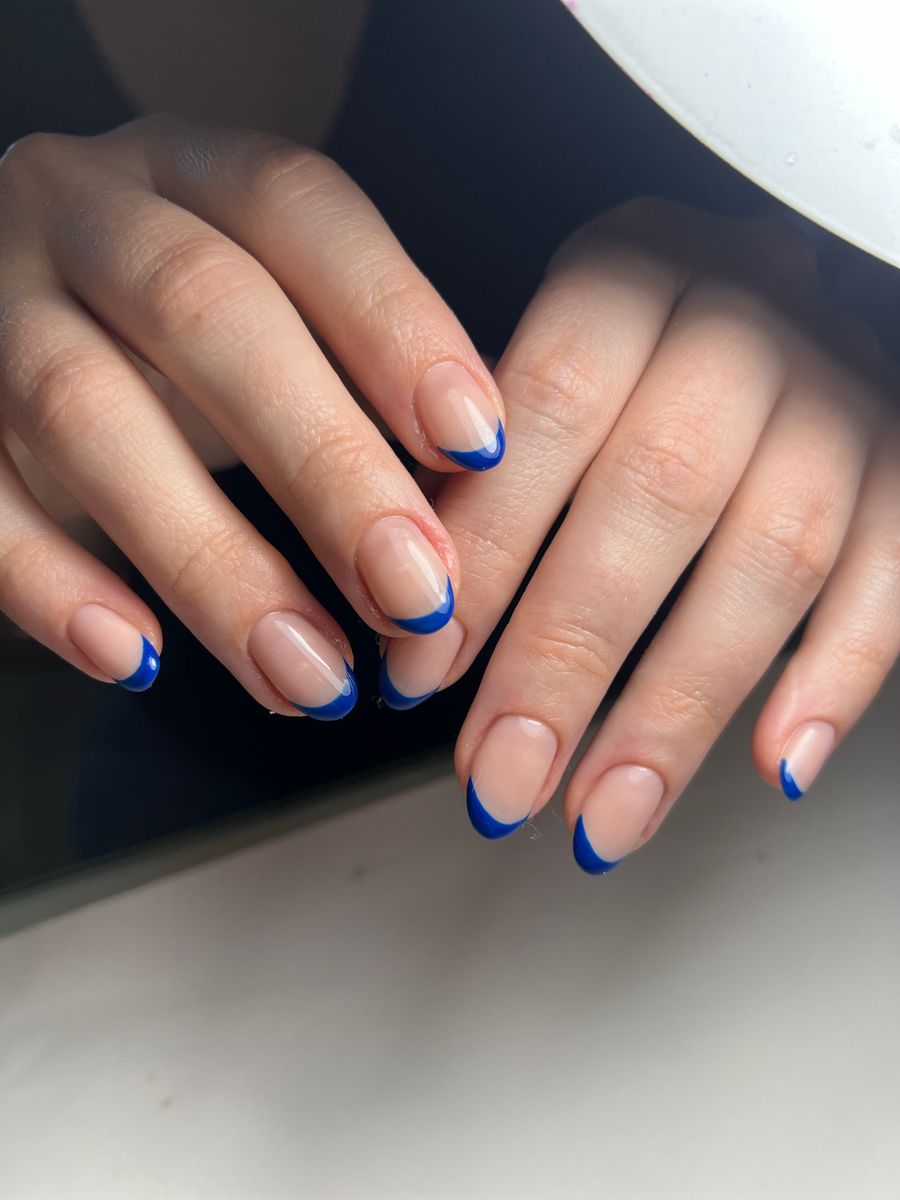
An AI nail design is ready for a salon discussion when its shape, length, colors, finish, and art placement are clear enough to explain—and obvious image errors have been removed or identified. Check the hand and nail boundaries, inspect the detail at a realistic size, and ask a nail professional which parts are achievable with your nails, service, and appointment.
“Salon-ready” should mean a useful reference, not a guaranteed blueprint. A realistic-looking image does not prove that the materials exist exactly as shown or that every tiny detail can be reproduced.
Judge the idea and the image separately
You can like the palette or composition of an image that contains errors. The useful response is to keep the idea while rejecting the misleading representation.
For example, a night-sky design might have an appealing dark base and scattered stars, but the generated image may add an extra finger or make a crescent float outside the nail. Those errors do not necessarily invalidate the color direction; they do make the image a poor literal reference.
Write down the parts you actually want. “Navy base, small silver-colored stars, one crescent accent” is a clearer starting point than asking a professional to copy the whole picture without qualification.
Keep the original image labeled as an AI concept if you share it. Do not present it as evidence that another salon has already completed the exact service.
First, inspect the hand and nail boundaries
Count visible fingers and check whether they connect naturally. Look for duplicated fingertips, merged fingers, unusually repeated contours, or a nail appearing on an implausible part of the hand.
Then inspect each nail individually. The design should sit within a coherent nail outline. Watch for polish spilling onto skin, a tip changing direction abruptly, or a pattern that crosses from one nail to another without explanation.
For a try-on using your own photograph, compare the result with the source. If the preview narrows the nail bed, lengthens fingers, or changes their proportions substantially, do not treat that change as evidence that the manicure suits your actual hand.
These are image-quality checks, not a health assessment. A preview cannot diagnose your nails or determine what service is appropriate for them.
Check whether the shape and length are consistent
An AI set can quietly mix different outlines or lengths. One nail may be softly rounded while another has a sharp point, even when the intended design is uniform.
Some variation may be intentional, but it should be clear. If the shape is inconsistent because of image generation, regenerate or use a simpler reference before deciding what to request.
Compare the pictured length with the length you want in daily use. Long references often provide more room for layered patterns. A shorter version may need fewer elements or a different placement.
Do not infer physical feasibility from a rendered outline. Ask the nail professional how the intended shape and length relate to your current nails and the service you are considering.
Inspect detail at a realistic viewing size
Zoomed images can make tiny motifs appear spacious and precise. View the design at a normal whole-hand size, then inspect which details remain meaningful.
Look for very small lettering, densely packed linework, or patterns that appear to change when you examine them closely. AI can suggest “intricate detail” without producing a coherent repeatable motif.
For a floral reference, check whether each flower has a recognizable structure or simply a cluster of petal-like marks. For stars or geometry, inspect whether the lines connect consistently. You do not need perfect symmetry, but the professional needs to understand what you are asking for.
If the main effect survives without the smallest details, ask for that simpler version. A few clear motifs may communicate the idea better than a dense pattern that only works in a large generated image.
Separate material effects from lighting effects
A bright patch might represent gloss, a reflective finish, a painted highlight, or a raised embellishment. The image alone may not make the distinction clear.
Point to the feature and describe what you like about it. “I want a soft reflective sheen” is different from “I want raised metallic pieces.” Let the professional explain which available material or technique could create an appropriate interpretation.
Color also depends on lighting and display. A translucent base may look opaque where the image has strong highlights. A metallic-looking detail may have impossible reflections. Compare real salon samples when exact finish matters.
Avoid assuming that a generated color effect corresponds to a single polish product. Treat it as a visual target to discuss, with room for a practical substitution.
Use a keep, clarify, or replace review
| What you find | How to use the reference |
|---|---|
| Clear palette, shape, and simple motif | Keep it for consultation and confirm feasibility |
| Attractive finish with unclear construction | Clarify the desired effect with the professional |
| Dense detail that disappears at normal size | Simplify the motif or reduce the number of accent nails |
| Distorted fingers or changed nail boundaries | Replace or regenerate the image before comparing fit visually |
| Mixed shapes or unexplained lengths | State the intended uniform version and obtain a clearer reference |
| A detail that cannot be described consistently | Replace it with a simpler, understandable element |
This review helps you avoid an all-or-nothing response. You can retain a strong concept while removing the parts that make communication difficult.
Keep a short note with the selected image explaining what is essential and what is flexible. The note prevents a corrected or simplified interpretation from feeling like an unexpected compromise later.
Ask the salon the questions the preview cannot answer
Show the reference before the appointment when the salon offers that option. Ask whether the art fits the service booked and whether the professional needs additional time or information.
Discuss shape, length, materials, detail level, and accent placement. Ask what changes would make the design practical for the actual nails and available products.
Confirm the price and appointment time directly. An AI image does not establish either. If the detailed version does not fit your plans, ask which simplification best preserves the overall look.
The salon reference-photo guide can help you explain your priorities without treating the image as an exact-copy demand.
For a hypothetical marble set, you might say: “The cream-and-brown palette matters most. I am flexible about the exact veins and would prefer fewer lines if that works better at this length.” That gives the professional a usable direction.
Regenerate with a more specific brief when needed
NailMoodLab supports prompt-based generation, hand-photo shape suggestions, and two-image virtual try-on. Generated designs can be regenerated, downloaded, shared, or copied by URL.
If the result is too complex, revise the prompt around the failed detail. Specify fewer motifs, a simpler finish, or a limited accent arrangement rather than adding more adjectives.
For example:
Short oval nail concept with a sheer warm neutral base, one small dark floral accent on each ring finger, flat art, generous open space, no raised decorations.
The prompt describes a direction, not a guarantee that every instruction will be followed. Inspect the new result using the same boundary, shape, and detail checks.
Use virtual try-on to explore the appearance on a hand photo, but do not let a convincing preview replace the professional's feasibility assessment.
Know when the reference is good enough
Stop regenerating when you can clearly explain the intended look and have removed the artifacts that would confuse the conversation. An endless search for a flawless image may not improve the actual salon brief.
Save one main reference and a simpler fallback. Label them so the professional knows which is preferred and which details can change. A practical decision record is more useful than a folder of many near-identical images.
Before sharing, confirm:
- The hand and nail boundaries are coherent.
- Shape and length preferences are explicit.
- The pattern remains understandable at normal size.
- Finish and raised-detail questions are identified.
- Essential and flexible features are written down.
- Time, price, and feasibility remain questions for the salon.
- The image is described as an AI concept, not a completed service.
Create a clear reference in NailMoodLab, review it carefully, and bring it to a nail professional as a discussion aid. For recurring design planning, check your current account allowance and available plan details; consider a future purchase only when checkout is available and the offer matches your actual use.