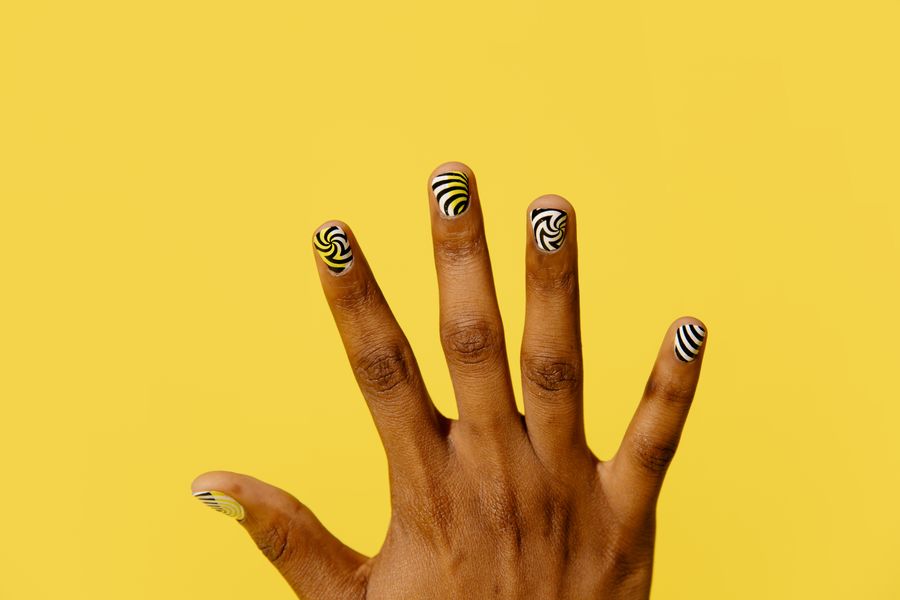
Having very short nails is often treated in nail salons as a temporary waiting phase. Many nail art tutorials assume there is some visible tip extending past the fingertip. When your nails are trimmed completely flush with the fingertip pulp, however, the unattached tip—known technically as the free edge—is practically nonexistent.
Having little to no free edge does not mean you have a naturally small nail bed. A person can have elongated, wide, or balanced nail beds and still keep their nails cut flush to the skin due to instrument playing, athletic requirements, healthcare work, typing, or personal preference.
If you are looking for design ideas tailored to shorter lengths in general, our foundational parent guide on short nail designs explores surface balance and daily routines. This guide focuses strictly on the mechanical constraint of having almost no free edge: how to place art when there is no overhang to paint, how to keep artwork clear of the nail's outer edge, and which styles flatter a flush-cut nail plate.
Why Nails With No Free Edge Need Different Art
In standard manicuring, technicians may "cap the free edge" by running polish along the outer lip of the tip.
When you have no free edge:
- You cannot cap the tip: Attempting to wrap polish over the edge may put product on the skin beneath or beside the nail.
- Impact lands directly on the edge: Daily activities can touch the outer edge of the polish.
- Paint pools against the distal groove: Applying product too close to surrounding skin can create an untidy edge.
In community discussions across platforms like Reddit (including shared routines in communities like r/shortynails and r/Nails), individuals who maintain ultra-short lengths frequently point out that designs failing at the tip usually fail because the art was conceived for longer extensions. Adapting your nail art means shifting visual weight away from the tip and onto the center and base of the nail plate.
5 Practical Nail Art Placements for Nails With No Free Edge
When decorating a nail with no free edge, prioritize designs that live entirely within the perimeter of the nail plate, leaving the distal boundary clean and unencumbered.
1. Base and Cuticle Accents (Reverse French and Half-Moons)
Instead of highlighting a nonexistent tip, anchor your design at the cuticle line. A reverse French manicure—tracing a fine, curved line just above the proximal nail fold—or a negative-space half-moon (leaving the lunula bare while polishing the rest) shifts the visual focal point downward. This shifts attention from the tip toward the base of the nail.
2. Micro-Dots and Constellations
Dots require virtually no free edge and avoid brush strokes that might pool at the tip. Using a fine dotting tool or the tip of a bobby pin, place a single contrasting dot near the base of each nail, or align two to three descending micro-dots vertically down the center line. This keeps the perimeter clean and leaves plenty of negative space, which helps prevent the nail plate from feeling visually overcrowded.
3. Vertical Linear Art and Negative-Space Stripes
Broad horizontal bands visually divide a short nail plate, making it look wider and more abrupt. In contrast, a single vertical pinstripe—painted down the middle or slightly off-center using a striping brush—draws the eye smoothly from the cuticle toward the tip without requiring a capped edge. For more ideas on restrained line work, explore our guide to minimalist nail art.
4. Floating Central Motifs
Place a single decorative element directly in the geometric center of the nail plate. Examples include a tiny hand-painted four-point star, an isolated metallic fleck, or a micro-floral accent. Leave a visible border of plain color or bare nail around the motif so the detail does not crowd the edge.
5. High-Impact Flats and Controlled Textures
Nail art does not always require pictorial illustration. A saturated solid lacquer with a high-gloss, velvet magnetic, or matte finish turns the natural silhouette of the nail into the design itself. Editorial trend roundups from publications like Vogue and brand lookbooks such as Manucurist's short nail series routinely highlight how rich, opaque cremes and clean monochrome blocks provide a deliberate, tailored look on short lengths.
The black-and-white pattern in the photo above shows how contrast can make a short manicure feel deliberate without relying on added length.
When a Traditional French Manicure Is Impractical
The classic French manicure is designed to enhance the natural white smile line of the free edge. When your nails have no free edge, attempting a classic French tip creates two distinct issues:
- Proportional distortion: A wide painted tip may take up much of the visible nail plate.
- Application smudging: Because the brush must stop right at the edge of the skin, polish can transfer onto the fingertip if the brush touches the skin.
The Workaround: The Micro-Outline or Side-Cuff
If you enjoy the French aesthetic, opt for a "micro-French" line that is very thin, painted in a dark or vibrant shade rather than white. Alternatively, consider a side-cuff or diagonal corner sweep that touches one lateral side of the nail rather than spanning the distal rim.
The Reality of Stickers, Decals, and Nail Wraps
Nail wraps and full-cover stickers are popular for DIY art, but many wrap instructions ask users to fold the material over the tip before filing.
When you have no free edge, this method poses distinct tradeoffs:
- Abrasion risk: Filing flush against the tip without an overhanging nail edge can file down and irritate the fingertip skin.
- Exposed edges: The wrap's edge may catch if it extends onto the skin or beyond the nail.
How to adapt stickers: Instead of full-cover wraps, choose small water-slide decals or adhesive stickers that sit strictly within the middle of the nail. If you do use full wraps, pre-trim the wrap with curved cuticle scissors before application so that it stays within the visible nail plate, then follow the wrap and topcoat instructions.
Salon Communication: How to Brief Your Technician
If you visit a salon, it helps to explain the length and shape you want before filing begins.
Use this quick brief at your next appointment:
- "Please do not file the sidewalls inward." Ask the technician to keep the file away from the surrounding skin.
- "Please keep the coats ultra-thin near the fingertip." Remind them not to cap the tip if it touches the skin; ask them to stop a hair’s breadth before the hyponychium to avoid flooding.
- "Focus the nail art near the cuticle or center." Specify that you want negative space near the tip so accidental edge wear will not disrupt the design.
Note on nail health: Ultra-short nails are sometimes the result of nail-biting, clerical wear, or past trauma. This guide addresses aesthetic styling only. If your nail beds are inflamed, peeling, or painful, avoid covering them with cosmetic products and consult a healthcare provider.
Testing Concepts Digitally Before Applying
Because placement on very short nails leaves limited space, testing color contrasts and placement beforehand can save cleanup time. You can experiment with layouts using NailMoodLab’s conceptual design tools and virtual try-on previews. Keep in mind that AI previews represent layout and color concepts; they do not guarantee physical fit, formula texture, or salon wear time on your specific nail shape.
Frequently Asked Questions
Can I get gel polish if my nails have no free edge?
Yes, but the nail technician must avoid letting gel cure on the skin around the fingertip pulp. Gel should be applied and cured according to the product directions without coating the surrounding skin.
Why do dark colors look so striking on very short nails?
Dark, saturated tones like espresso, navy, and deep burgundy create a sharp, intentional silhouette. On very short nails, they look neat and graphic rather than vampy or overwhelming.
How do I shape nails that have no free edge?
Follow the natural curve of your fingertip pulp using a gentle file. Avoid squaring off sharp corners that might dig into lateral nail folds. For detailed comparisons of perimeter geometry, see our analysis of square vs. squoval shaping.