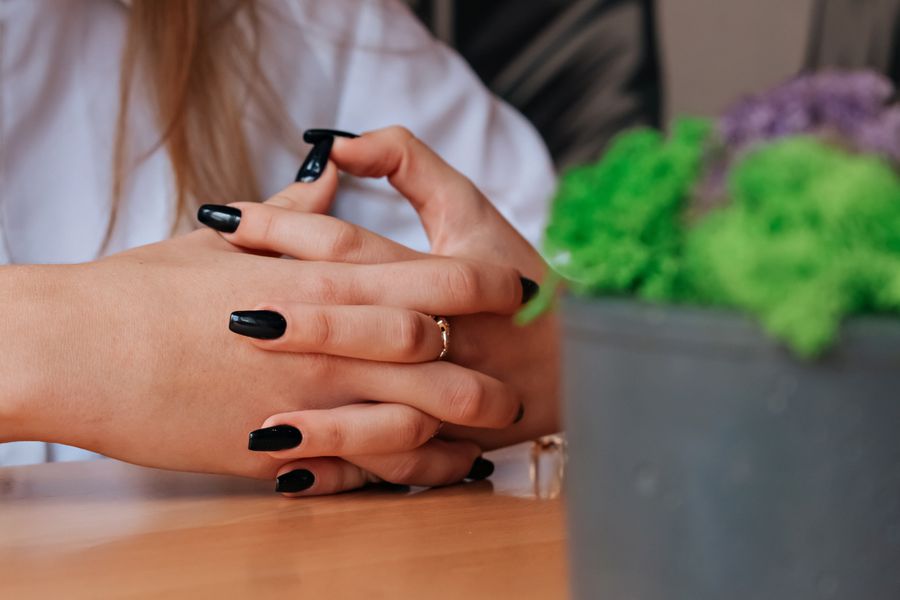
To choose matte vs glossy nails, compare the same palette and motif at the same planned length under similar lighting. If one reference is short, dark, and simple while the other is long, pale, and decorated, you are choosing between whole designs—not isolating the finish.
Glossy references emphasize shine and reflected highlights; matte references present a lower-shine appearance. Neither label establishes nail health or guarantees better wear. Make the visual choice first, then ask your artist about the actual products, care, and maintenance involved.
Keep the design fixed long enough to compare it
Write a short description of what should not change: nail length and shape, base color, motif, placement, and any embellishments. Then add the finish as the one variable you want to explore.
For example, “short rounded nails, deep blue base, ivory crescent accent” can remain constant while you compare matte-looking and glossy-looking versions. If one version suddenly has a brighter blue or an extra metallic border, that is not a clean finish comparison.
Shape is worth settling separately. If your references mix tapered silhouettes, use Stiletto vs Almond Nails or Almond vs Coffin Nails to clarify that choice first. Otherwise, a preference for one silhouette may be mistaken for a preference for its finish.
You do not need an exact photographic match to begin a discussion. You do need to notice the differences and avoid attributing all of them to matte or gloss.
Look at the reflection, then the design beneath it
In a glossy reference, a bright highlight may cross the motif or form a visible streak along the nail. Ask whether you enjoy that shine as part of the design. Also check whether the highlight temporarily obscures a small detail you want to see.
In a matte reference, judge the color areas and linework without expecting the same bright reflected streak. Does the lower-shine appearance support the motif you chose, or do you miss the reflective element? Neither answer needs to become a rule for every manicure you wear.
Keep lighting in mind. A glossy nail photographed without a prominent reflection should not automatically be labeled matte. Likewise, an edited or generated highlight does not prove a particular real finish. When possible, ask to see comparable salon samples under the same light and view them from more than one position.
Do not infer touch from appearance alone. Descriptions such as “velvety” or “glass-like” may convey a visual impression, but a picture cannot tell you exactly how the finished surface feels.
Use a comparison sheet instead of choosing a winner immediately
Record specific observations rather than deciding that one finish is universally better. This helps you distinguish a preference for shine from a preference for the particular photograph.
| Question | What to record |
|---|---|
| Is the palette comparable? | Any change in shade or apparent opacity that could affect the choice |
| Does the motif remain the same? | Added, removed, enlarged, or repositioned details |
| What does the highlight do? | Whether you like it, barely notice it, or find it distracting in this design |
| Does the full set feel consistent? | Whether the finish suits both plain and patterned nails in your chosen reference |
| What still needs a real sample? | Color, surface appearance, or mixed-finish contrast that an image leaves uncertain |
If the palette has changed substantially, keep the image as a separate design option rather than using it as evidence about finish. You can still prefer it; just name the reason accurately.
For a detailed pattern, inspect both a closer view and the whole hand. A finish that appeals in a close-up may not be the feature you notice most in the complete set. For plain nails, the reflection itself may be a larger part of the decision.
Mixed finishes are a placement choice
You do not have to select one finish for every part of the manicure. You might want a glossy accent among matte-looking nails, or a glossy detail against a lower-shine background. But treat that as a third design proposal rather than assuming it is an automatic compromise.
Specify where each appearance belongs. “Matte base with a glossy tip” is different from “mostly matte nails with one glossy accent.” The boundary and distribution matter, particularly when the color remains the same.
Ask your artist whether they offer the intended combination and how they would interpret the reference. A generated image may exaggerate the difference between finishes or depict a boundary that will not translate exactly. Do not use it as proof of the service's feasibility.
If the finish contrast is difficult to identify in a preview, avoid adding unrelated colors immediately. First determine whether you still want that subtle contrast or would prefer one consistent finish.
Separate maintenance questions from aesthetic votes
Online preferences can help you identify what people notice, but they do not establish which finish will last longer for your service. In one public discussion, responses included both enthusiasm for matte and a preference for gloss over time. Those are personal reactions, not a controlled durability comparison. Read the discussion.
Ask the technician about the specific finish and service you are considering:
- What appearance should I expect as this particular service wears?
- Are there different care instructions for these options?
- What maintenance or removal will the chosen service involve?
- If I want a mixed-finish design, are there practical limits I should know before booking?
Mention relevant everyday activities so the discussion is specific to your use. Do not assume matte means less durable, glossy means stronger, or either finish proves healthier nails. A visual preference is not a substitute for product-specific guidance.
Example: choosing shine without changing the whole idea
Imagine a client planning short rounded blue nails with an ivory crescent accent. This is a hypothetical example. They save a matte image because the crescent is clear, but they also like a glossy image with a brighter shade and a different shape.
Before choosing, they could return to the original blue, rounded silhouette, and crescent placement, then compare finish alone. If the glossy highlight is the appealing feature, they can discuss that version with the artist. If they prefer the brighter shade instead, that becomes a separate palette decision.
The appointment note might read: “Keep the short rounded shape, blue shade, and ivory crescent. I prefer a glossy appearance, but would like to see the available finish sample before confirming.” This states a preference without pretending a digital comparison was a wear test.
Use a creative preview with a written baseline
In NailMoodLab, describe the same length, palette, motif, and placement when requesting each finish direction. Change the finish wording and inspect what else changed. This is not a guaranteed finish-only editing control; separate generations may vary other details.
Use the optional Things to avoid field for unwanted additions, then download useful design images and keep the baseline description with them. Generation requires sign-in and available AI allowance. Check current allowance, plans, and billing options before planning repeated use or paid access.
For hand try-on, supply both a clear hand photo and a design image. The preview may alter details and cannot verify real reflection, texture, fit, durability, or salon feasibility. Use it to explain the look you favor, then confirm the actual finish and care expectations with your nail artist.