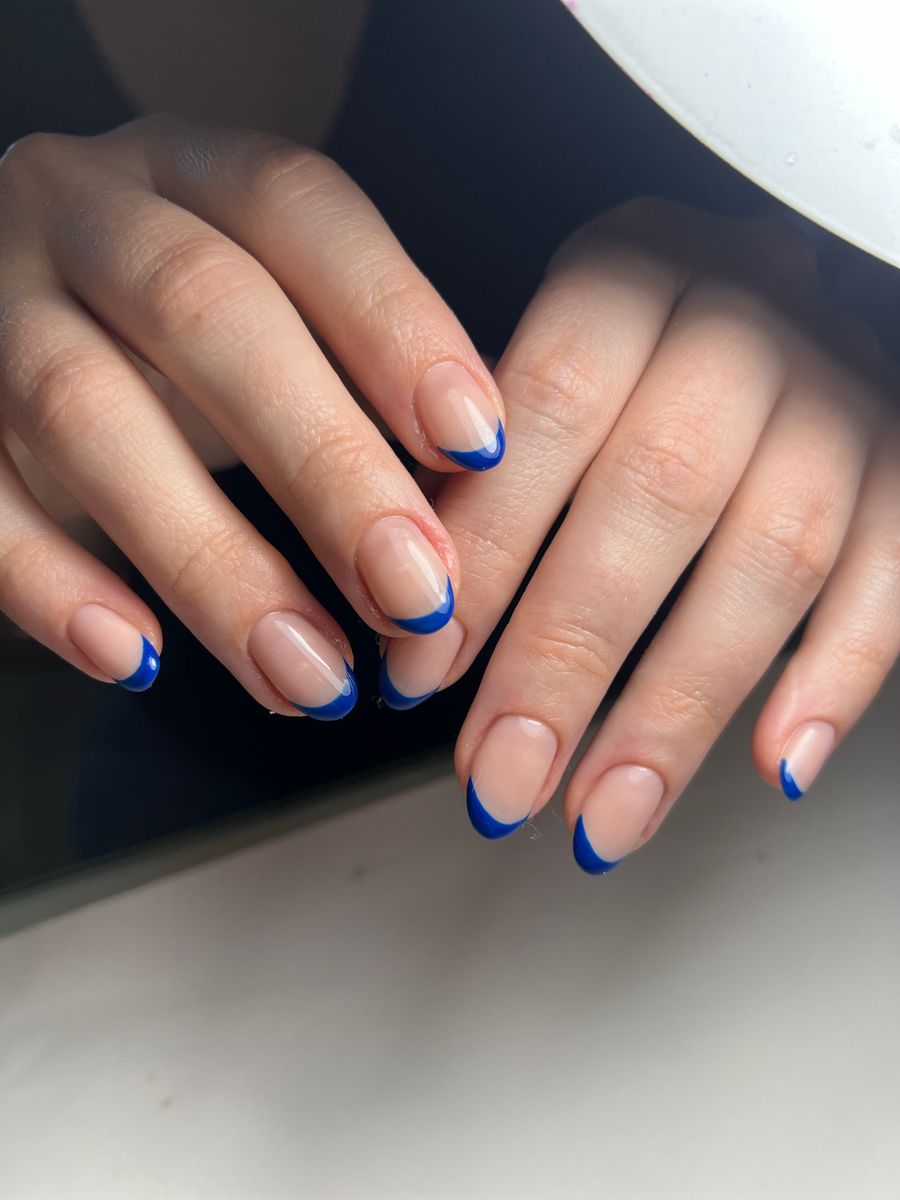
The most readable celestial nail ideas use a clear hierarchy: one main moon or star motif, smaller supporting details, and enough open background to suggest a sky. Choose your base color, motif scale, and accent placement before adding shimmer or metallic-looking effects. For shorter nails, simplify the scene rather than shrinking a dense star field unchanged.
Celestial art can be subtle or dramatic. A single crescent on a sheer base and a dark full-set galaxy concept share a theme but create very different impressions. Start with the amount of visual attention you want the manicure to draw.
Choose the background before the stars
Sheer or pale neutral
A sheer-looking or pale base makes the celestial detail feel light and restrained. A few small stars or one crescent can become the main feature without filling the nail.
Keep enough contrast for the motif to remain visible. A pale metallic-looking star on a very light base may disappear outside a close-up. Compare the reference at normal viewing size before choosing it.
Deep navy or near-black
A dark base creates a stronger night-sky association and makes light motifs more prominent. The main challenge is density: every bright dot can attract attention, so placement matters.
Use larger empty areas if you want the set to feel calm. A dark base does not require every nail to contain a moon, several stars, and extra shimmer.
Muted blue, mauve, or another soft color
A colored base can create a less literal interpretation of the theme. Choose the star or moon color in relation to it rather than automatically adding both gold and silver effects.
Keep the palette limited enough that the motifs remain the focus. If you introduce several background colors, repeat a clear motif style or finish to connect the set.
Select a small family of motifs
Stars can appear as simple points, small crosses, or more detailed shapes. Moons can be crescents, circles, or a sequence of phases. Choose the visual language you want instead of mixing every version.
A simple star style repeated at different sizes can feel more coherent than several unrelated star shapes. A crescent can act as the focal point while dots or smaller stars provide support.
If a specific constellation matters to you, bring a clear reference and identify it explicitly. Do not assume a decorative AI-generated line pattern represents the intended constellation accurately.
Likewise, decide whether a moon-phase sequence needs to be exact or simply evokes the theme. A small nail canvas may require a simpler interpretation. Make that distinction clear in the salon conversation.
Five placement ideas to compare
One crescent accent
Place a crescent on a selected nail and keep the rest plain or lightly dotted. This makes the moon the unmistakable focal point.
For a shorter nail, use a clear crescent with space around it rather than adding several tiny companions. On a longer nail, adjust placement and spacing before increasing detail.
Sparse stars across the set
Repeat a few small stars with varied placement. Keep their style and contrast related so the set feels intentional even when no two nails are identical.
Leave some nails quieter than others. A solid-color nail or a single point can balance a more detailed accent.
A night-sky tip
Use a dark tip area with a small light motif or a few points. The restricted area means the design needs simpler detail than a full-nail sky.
Check whether the tip remains readable at your chosen length. If it becomes a narrow busy band, reduce the motif count or move the celestial detail onto a full accent nail.
A moon-and-star pair
Use one main moon on one accent and a larger star on another, supported by a consistent base across the set. This distributes emphasis without making every nail equally busy.
Decide whether both hands repeat the same arrangement or use related variations. Include the thumbs so the complete set is planned.
A flowing constellation-inspired line
Use a sparse line connecting a few points, with enough open space to keep the path visible. This can create movement along a longer canvas or a simplified accent on a shorter one.
Keep the linework understandable. If the generated reference turns into a tangled network, simplify it before presenting it as a precise request.
Scale the design to the nail length
| Canvas | Starting approach | Detail to reduce first |
|---|---|---|
| Short | One main motif or a few clear points | Dense clusters and miniature phase sequences |
| Medium | A focal motif with supporting stars | Repeated tiny decoration with no clear role |
| Long | Extended spacing or a flowing composition | Extra motifs added only to fill the space |
The table is a design starting point, not a guarantee of what can be applied to your nails. The actual shape, width, service, and professional's approach all affect the interpretation.
If you shorten a long reference, keep the main idea rather than every detail. A dark palette and one crescent can preserve the celestial identity even after a complex background is removed.
The minimalist nail-art guide can help you choose supporting details that leave the focal motif clear.
Decide how reflective the finish should be
A glossy base, shimmer, chrome-like appearance, and metallic-looking motifs create different effects. Identify which one you want instead of assuming every bright highlight in a reference is part of the design.
If the motifs already have strong contrast, a quieter base can keep them legible. If the background has a prominent reflective effect, fewer motifs may help prevent visual competition.
Clarify whether you prefer flat art or are open to raised pieces. A generated star can look like a painted shape in one area and an embellishment in another.
Ask the salon which available products or techniques can create the intended appearance. A screen image cannot establish an exact finish or guarantee that every AI reflection corresponds to a real material.
Generate a concept with controlled density
NailMoodLab offers prompt-based generation, hand-photo shape suggestions, and two-image virtual try-on. Generated designs can be regenerated, downloaded, shared, or copied by URL.
Try a focused prompt:
Short oval celestial nail concept with a deep navy base and glossy finish. Place one small silver-colored crescent on each ring finger and a few simple star points on selected nails. Leave generous empty space. Flat art only, no large gems or extra colors.
Inspect whether the output follows the motif count and placement. If it becomes crowded, ask for fewer stars while keeping the same palette. If the stars are unclear, simplify their shape rather than adding more decoration.
For a softer comparison, change the base color while retaining the same layout. This helps you judge palette preference separately from density and motif placement.
Use virtual try-on to explore the appearance on one clear hand photo. Compare the preview with the source and reject distortions to fingers or nail boundaries. The result is not a measurement, fit assessment, or feasibility guarantee.
Prepare a salon reference that leaves room for adaptation
Choose one image and describe the essential features in plain language: base color, moon or star style, accent placement, finish, and the amount of open space.
The salon reference-photo guide can help you explain priorities. A useful brief might be: “Keep the navy base and one crescent per hand; the small stars can change, and I prefer flat detail.”
Ask whether the design fits your chosen length, service, time, and budget. Keep a simpler fallback, such as one accent with the other nails plain, if the detailed version is impractical.
Before deciding, confirm:
- The background and motif colors have clear contrast.
- One main motif leads the composition.
- Density suits the chosen canvas.
- Both hands and thumbs are planned.
- Reflective or raised effects are clarified.
- Generated details are coherent and inside nail boundaries.
- The professional has confirmed the practical interpretation.
Explore one celestial direction in NailMoodLab, then bring the clearest reference to your nail professional. For regular planning, review your current account allowance and available plan information. Consider a future purchase only when checkout becomes available and the offer fits your actual use.